
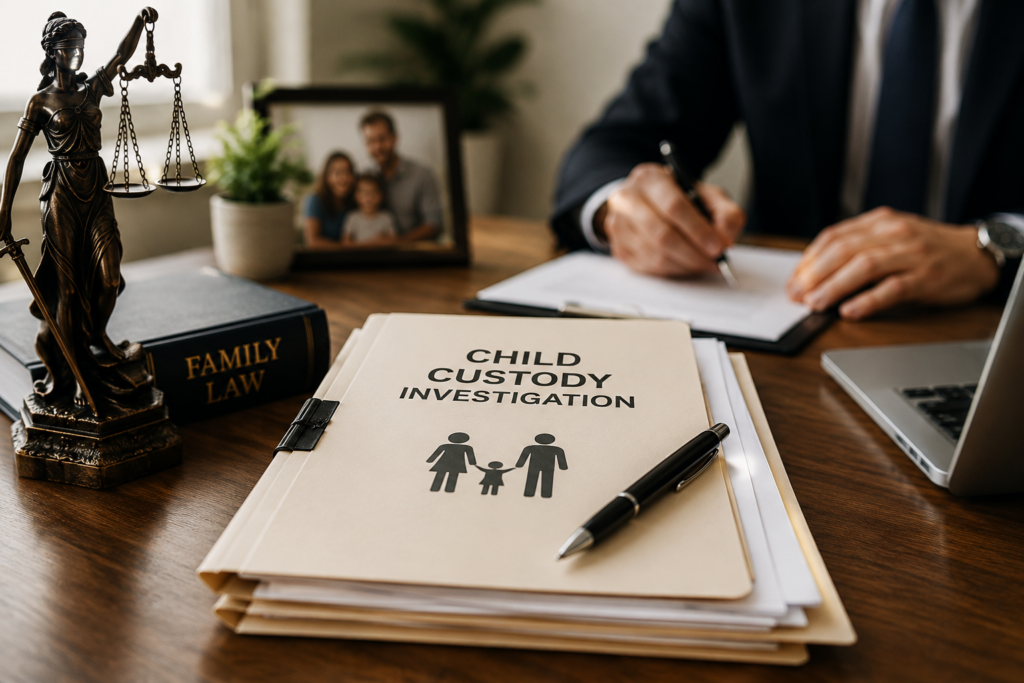
When parents contact my office about a child custody investigation, one of the first questions they often ask is, “How many hours of surveillance do you think we’ll need?”
My answer isn’t always what they expect.
After more than 30 years as a private investigator, I’ve learned that effective child custody investigations are rarely accomplished in a single afternoon or evening. In most cases, I recommend budgeting for at least 40 hours of surveillance, strategically conducted over multiple days.
Why? Because a child custody investigation should be about establishing patterns of behavior, not simply capturing one isolated incident.
Patterns Tell a Story. Isolated Incidents Often Don’t.
When conducting a child custody investigation, our objective is to document a parent’s activities, habits, judgment, and behavior as they relate to the child’s well-being.
One afternoon of surveillance might reveal very little. The parent may behave responsibly that day, or we might observe something questionable that turns out to be an isolated occurrence.
Neither observation necessarily tells the whole story.
However, when surveillance is conducted over multiple days, at different times, and under different circumstances, a much clearer picture can begin to emerge.
For example:
- Does the parent consistently follow established custody schedules?
- Are children being properly supervised?
- Does the parent routinely leave the children with other individuals?
- Are there recurring activities or behaviors that raise legitimate concerns about the child’s safety or welfare?
- Is the parent complying with restrictions established by the court?
- Are there inconsistencies between what the parent represents to the court and what actually occurs?
These are questions that often cannot be answered through a single surveillance assignment.
You cannot establish a meaningful pattern of behavior with just one bite at the apple.
Why Surveillance Should Include Time With and Without the Children
One aspect of child custody investigations that I believe is frequently overlooked is the importance of observing a parent both when the children are present and when they are not.
Surveillance conducted while the parent has custody can help document how that parent fulfills their responsibilities, including supervision, transportation, daily routines, and compliance with court-ordered arrangements.
But surveillance when the parent does not have the children can sometimes be equally important.
It may reveal recurring activities, associations, or behaviors that warrant further investigation, particularly when there are specific allegations involving substance abuse, unsafe environments, or other conduct potentially affecting the children.
That does not mean a parent’s private activities automatically make them an unfit parent. They do not.
The objective is to document relevant facts, not to make assumptions or pass judgment.
A professional investigator should be looking for information that can be objectively documented and, when appropriate, evaluated by the client’s attorney.
Why I Often Recommend a Minimum of 40 Hours
Forty hours is not a magic number, nor is it a legal requirement.
It is a practical starting point that I often recommend based on my investigative experience.
Those hours should not necessarily be conducted consecutively. In fact, spreading surveillance across strategically selected days and times may be far more productive.
A well-planned investigation might include weekdays, weekends, school pickup and drop-off periods, evenings, and scheduled custody exchanges.
The goal is to observe enough activity to determine whether particular behaviors are repeated.
A parent who is observed engaging in questionable conduct once may have an explanation. When similar conduct is documented repeatedly, under different circumstances, the observations may carry greater significance.
This is particularly important when an attorney is attempting to establish a recurring pattern rather than relying on a single allegation.
Of course, even 40 hours cannot guarantee that a particular pattern will be identified. Every case is different, and the investigation should be guided by the facts and available evidence.
When a Single Surveillance Assignment May Be Enough
There are exceptions.
Not every child custody assignment requires 40 hours of surveillance.
For example, suppose a parent has specific information that the other parent intends to violate a court order by taking the child somewhere expressly prohibited.
If the suspected violation is expected to occur on a particular date, a single properly timed surveillance assignment may be sufficient to document that event.
Other examples might include documenting a specific custody exchange, confirming a particular allegation, or observing compliance with a clearly defined provision of a parenting plan.
In those situations, we may be looking to establish whether a particular incident occurred rather than attempting to establish a broader pattern of behavior.
Sometimes one surveillance session is enough to answer the question. Other times, 40 hours or more may be necessary to develop a meaningful picture.
The key is understanding the objective before the investigation begins.
A Child Custody Investigation Should Be Planned, Not Rushed
I have always believed that a good investigator should explain to a client what can realistically be accomplished with the time and resources available.
If someone hires an investigator for four or five hours, they should understand that the results will be limited to whatever can be observed during that period.
That may be perfectly acceptable for a narrowly defined assignment.
But if the objective is to establish a continuing pattern of questionable behavior, a few hours of surveillance may not be enough.
Proper planning, selecting productive surveillance periods, maintaining accurate documentation, and obtaining clear video evidence when possible are all essential components of a professional investigation.
Just as importantly, investigators must conduct themselves lawfully, respect privacy rights, and avoid unnecessarily involving children in investigative activities.
The Goal Is Credible Evidence, Not a Predetermined Outcome
Child custody matters are among the most sensitive investigations we conduct.
These cases involve families, children, and decisions that can have lasting consequences.
At Optimum Investigations, our responsibility is not to prove that one parent is right and the other is wrong. Our responsibility is to document facts objectively and professionally.
Sometimes the evidence supports a client’s concerns. Sometimes it does not.
Either way, the findings should be accurate, properly documented, and capable of being presented to legal counsel for evaluation.
After more than three decades in this profession, one thing remains clear to me:
Good investigations take planning, patience, and sufficient time to establish the facts.
When it comes to child custody investigations, one day may capture an incident. Multiple days may reveal a pattern.
And that distinction can make all the difference.
Need a Professional Child Custody Investigation in South Florida?
Optimum Investigations LLC provides professional child custody surveillance and investigative services throughout Broward, Miami-Dade, Palm Beach, and surrounding South Florida communities.
With more than 30 years of investigative experience, we work with private individuals and attorneys to develop appropriately planned investigations focused on obtaining factual, legally obtained evidence.
Contact Optimum Investigations to discuss your concerns and determine an appropriate investigative strategy.
Florida Licensed Private Investigative Agency — License #A9500084